
Anderson County Deed Records Lookup
Anderson County deed records are kept by the Register of Deeds in Clinton, and they are the right place to start when you need a recorded deed, a trust deed, a plat, or a lien tied to local land. The county has long-running records, and the office supports both walk-in work and online searching through TitleSearcher. If you are tracing a chain of title, checking a grantor or grantee, or trying to get a copy of a document, the county records are the core source.
Anderson County Deed Records Quick Facts
Anderson County Deed Records Office
The Anderson County Register of Deeds office is in Room 205 at 100 North Main Street in Clinton. Tim Shelton serves as Register of Deeds, and the office keeps the county's deed books, indexes, and other real property records. Hours run Monday through Friday from 8:00 AM to 5:00 PM. The office can also help with certified copies and book and page references.
Anderson County is one of the few counties that does not charge a subscription fee for online access. That helps a lot if you need to check a name, date range, or document type more than once. The TitleSearcher portal supports grantor, grantee, date range, and document type searches, and it includes document images for computerized records. That makes it useful for both quick checks and deeper title work.
The office contact details are simple to keep close. The phone numbers are (865) 457-6236 and (865) 457-6235. The fax number is (865) 457-1638, and the office email listed in the research is tim.shelton@titlesearcher.com. If you are planning a visit, call ahead when you need a copy pulled from an older book or need help with a record that is not yet online.
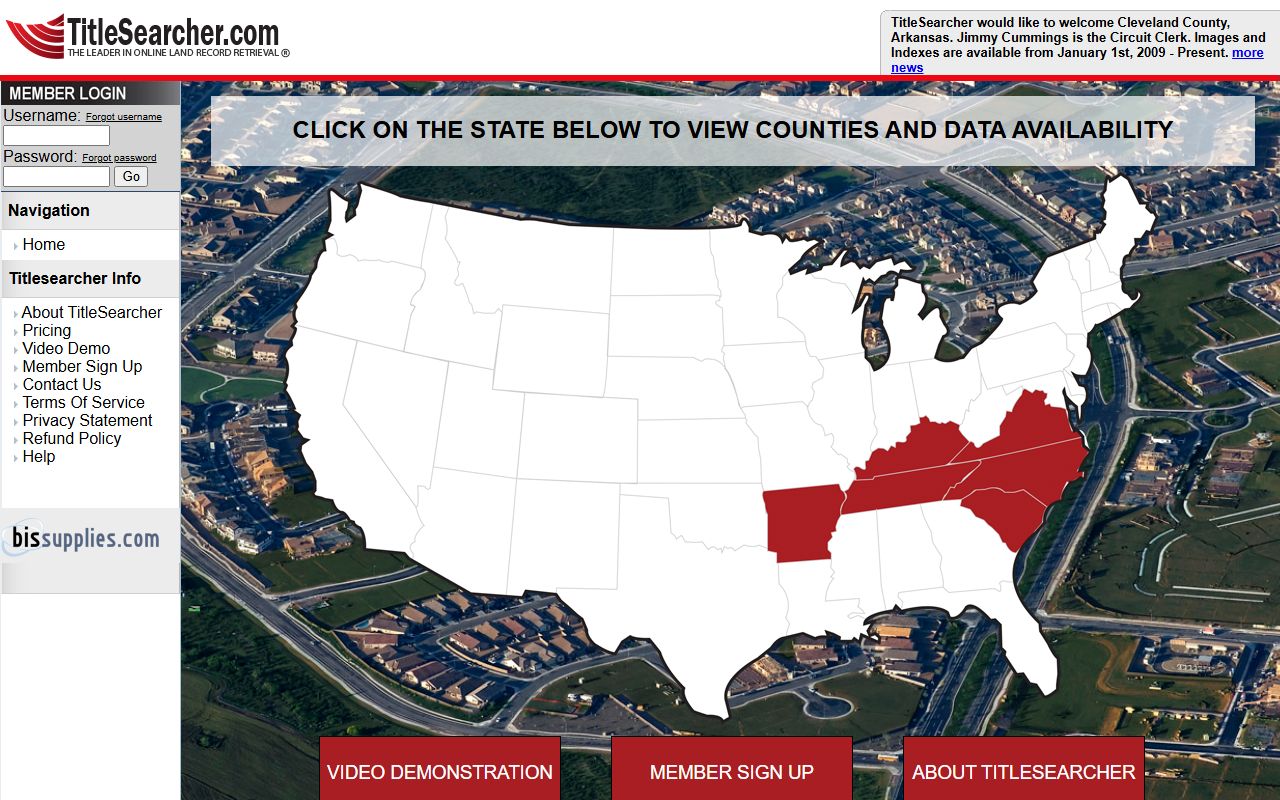
The Anderson County TitleSearcher portal is the county's main online search path, and it is especially useful when you already know a grantor, a grantee, or a recording date. It also gives you a direct way to compare index entries with the document image.
That helps narrow searches fast, and it is often the best first stop before you ask the office for a copy.
Search Anderson County Deed Records
Start with the name you know. Grantor and grantee searches are the fastest way to find a deed in Anderson County, because the county index is built around the people in the transaction. If you only know the property address, you may still get there by using the parcel record or by checking the legal description on an assessment page. The county also has a free fraud alert service, which can help you watch for new filings under a name you care about.
The county record set goes back to 1801, so old chains of title can take a little patience. That is where the Tennessee State Library and Archives helps. Its county records microfilm collection at TSLA county records gives researchers another path when the courthouse index is old or hard to read. For some searches, the old book and page reference matters more than the exact deed date.
When you search Anderson County deed records, these details help most:
- Grantor or grantee name
- Approximate recording date
- Book and page number if known
- Property address or parcel number
- Document type such as deed, trust deed, or plat
If you need a wider view, the county directory at CTAS Registers of Deeds is useful for cross-checking office details across Tennessee. It is a clean way to verify that you are using the right county office before you request records in person or by mail.
Anderson County Deed Records Fees
Anderson County posts a clear fee schedule in the research, and it is helpful when you need copies or want to record a new instrument. The standard recording fee is $5.00 per page for regular documents. There is also a $2.00 computer fee per non-UCC instrument. Those two charges are the ones most people notice first when they record a deed or ask for a fresh copy.
Transfer tax and mortgage tax also matter. Anderson County collects a transfer tax of $0.37 per $100 of consideration, rounded up, and a mortgage tax of $0.115 per $100 of indebtedness after the first $2,000. Certified copies are $1.00 per page, and non-certified copies are $0.50 per page. Plats cost more because of the larger format, with the first page at $15.00 and later pages at $5.00 each.
Those fees line up with state rules in T.C.A. § 67-4-409 and the CTAS guide to recording requirements. The county also supports e-recording through Simplifile and CSC. That is worth knowing if you are sending in a deed from a title office or lender and want proof of filing faster than mail can move it.
Note: Fee totals can change with page count, tax due, and the number of instruments in one document, so confirm the exact amount before you file.
Anderson County Recording Rules
Tennessee recording rules apply in Anderson County just as they do elsewhere. The county must be able to read the document, index it, and match it to the correct parcel. The CTAS legal guide and the state code give the basic framework. Under CTAS recording rules, deeds need original signatures, a valid acknowledgment, owner and taxpayer information, a preparer name and address, and a parcel identification number.
The county also relies on a derivation clause to show where title came from. That clause helps tie the new deed back to the older record. If tax is due, it must be paid before the register can accept the document. That includes transfer tax on sales and mortgage tax on debt instruments. The general rule is simple: if the office cannot index or lawfully accept the paper, the recording stops until the problem is fixed.
The same state rules help explain why certain deeds move fast and others do not. A clean deed with the right notary block, the correct parcel ID, and clear names is much easier to record. A missing witness, a bad legal description, or a skipped tax line can force a delay. The county's office can help you spot the issue before you stand in line twice.
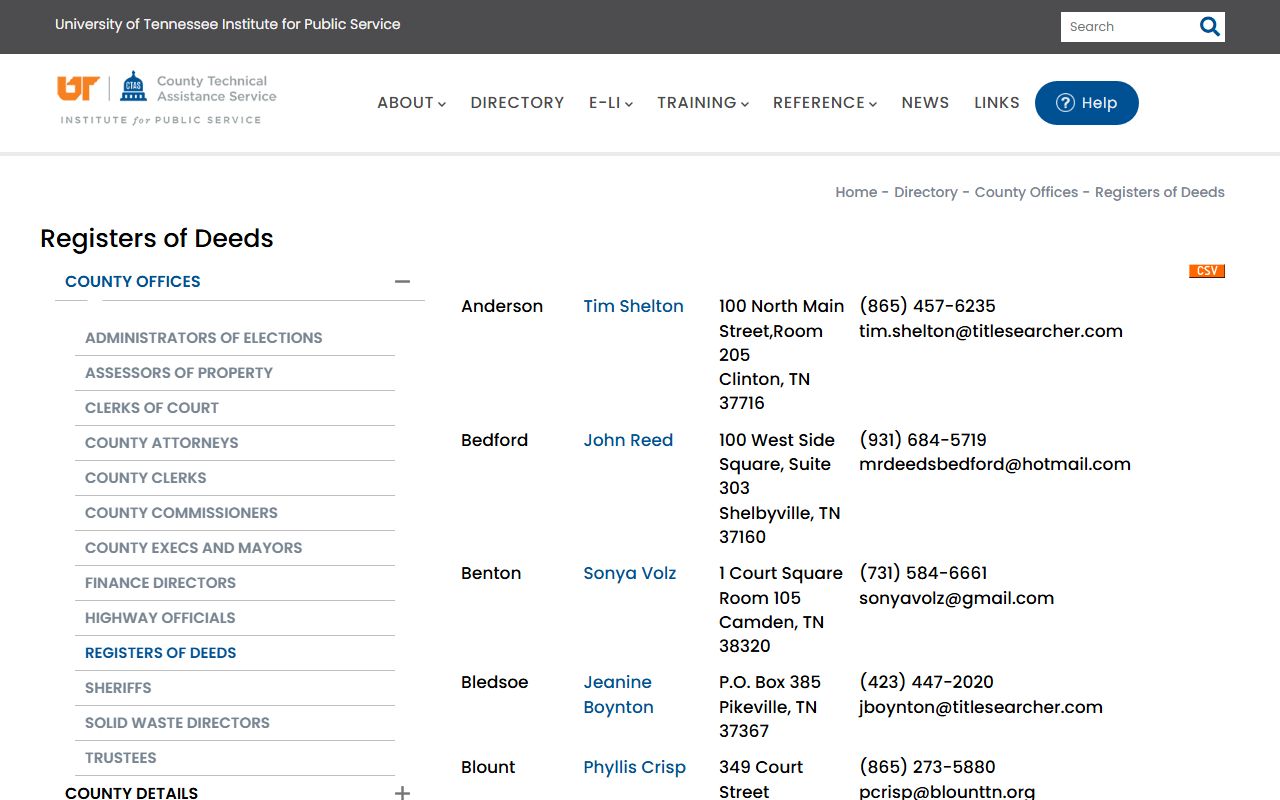
The CTAS directory is also a quick way to confirm the county office structure and contact path before you file a deed in Anderson County.
That matters when you need a clean handoff between the office, the lender, and the title work.
Historical Anderson County Deed Records
Anderson County has a deep record set, and that helps when you are tracing older family property or checking a long chain of title. Original deed books are preserved at the courthouse, and microfilmed copies are available through the Tennessee State Library and Archives. Early periods may also use manuscript entries, so the book image and the index both matter. You may need to search both grantor and grantee names to get the full picture.
Those older records often show more than a sale. They can include releases, powers of attorney, liens, military discharges, subdivision plats, and other filed papers that shape title. If you are trying to understand how a parcel changed hands, it helps to see the deed next to the release and the later conveyance. That is where the county's book and page system still earns its keep.
The county also offers a free property fraud alert service. It sends an email when a document is recorded under a subscriber's name. That is not a substitute for title work, but it is a strong warning tool. In a county with a long deed history, that kind of notice can be useful when you want to know fast if a new filing appears.
Note: Recorded deeds are public, but some related papers can be limited or redacted when state law protects part of the file.
More Tennessee Deed Records
Use the county and state resources together when you need a full answer. The county office handles the live record, while the state archive and CTAS material help you verify process, history, and record type. If you are moving from one county search to another, the county index and the state guidance will keep you from guessing at the rules.
You can browse more county pages at Tennessee counties and compare office paths through the Tennessee Registers Association. For broader public access rules, the Tennessee Public Records Act at T.C.A. § 10-7-503 explains why recorded deeds are open during business hours.