
Moore County Deed Records Search
Moore County deed records are the place to start when you want to verify ownership, follow a parcel, or pull a recorded document tied to land in Lynchburg and the rest of the county. The register keeps the county's official land file, and the state tools help when you need older record runs or a better parcel clue. If you already know a name, a tract, or a recording year, Moore County is the kind of place where a focused search can move quickly from the index to the document itself.
Moore County Quick Facts
Moore County Deed Records Office
The CTAS county register directory is the simplest state-level entry point for Moore County, and the image below points to that county source. It gives you a quick office reference before you request a copy or visit Lynchburg.
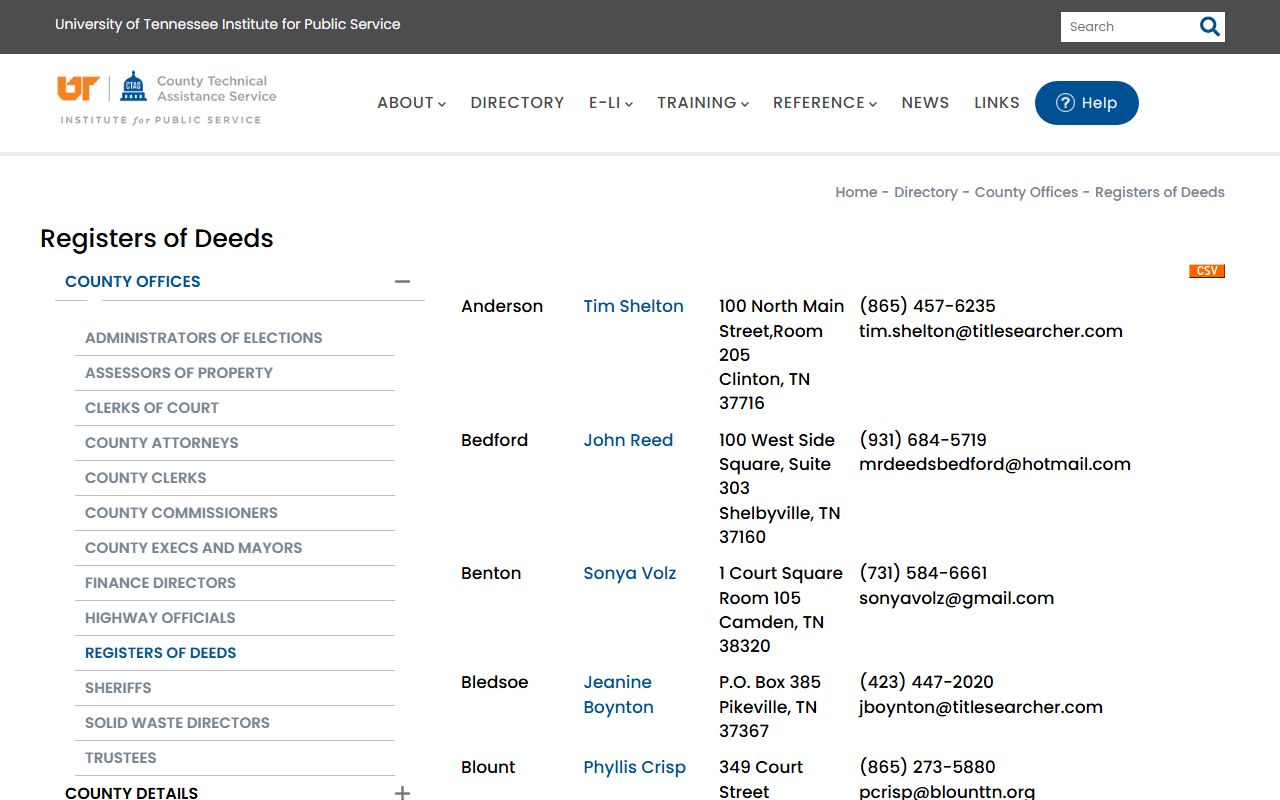
That directory helps connect Moore County deed records to the right register office and the right contact trail.
The Register of Deeds in Moore County is Pam Wells. The office is at 196 Main Street, P.O. Box 206, Lynchburg, TN 37352. The phone number is (931) 759-7913, the fax number is (931) 759-6394, and the email listed in the research is mooretn@titlesearcher.com. The office keeps the county's deeds, mortgages, liens, and related land records. That keeps the title trail tied to the county where the land sits.
Moore County land records begin in 1871. That is recent enough for many modern searches, but still old enough that you may need a good date range when you look through older deeds. A property can change hands several times in a county with this much history. When that happens, a tight search window saves time and keeps the chain of title easier to read.
| Office | Moore County Register of Deeds, Pam Wells |
|---|---|
| Address | 196 Main Street, P.O. Box 206, Lynchburg, TN 37352 |
| Phone | (931) 759-7913 |
| Fax | (931) 759-6394 |
| mooretn@titlesearcher.com |
Search Moore County Deed Records
Moore County deed records are easiest to search by name. Start with the grantor and grantee. If you only have the tract, use the parcel clue or the legal description to narrow the field before you search the index. That is especially helpful in a county where older records may need a book-by-book approach rather than a broad portal search. Once you know the likely time range, the search gets much faster.
State tools give the search another layer. The TNMap assessment portal is useful for parcel IDs, owner names, and legal descriptions. The CTAS assessor property records guide shows how those tax records complement deed records. If a property has passed through family hands or changed shape over time, the tax card may be the clue that gets you back to the right deed book.
Business ownership can matter as well. The Tennessee Secretary of State business search helps verify company names and filing history when the deed names a business rather than an individual. That is a useful check in Moore County because an entity name can be easy to misread when it appears in an older deed or a trust deed.
These details help the most in Moore County:
- Grantor and grantee names
- Approximate year of filing
- Parcel ID or legal description
- Document type, such as deed, mortgage, or lien
- Book and page number if available
With those clues in hand, the county office can usually point you in the right direction fast.
Moore County Deed Records Rules
Moore County follows the Tennessee recording rules that govern every register of deeds office. The state guide at this PDF explains the key standards. Legibility, acknowledgment, owner and taxpayer data, the preparer's name, the derivation clause, and the parcel identification number all matter. If any one of those pieces is missing, the office may have trouble indexing the filing.
A deed of trust can also bring tax and witness rules into play. A release has to point back to the right file reference. A plat has to be clear enough to reproduce. That is why a clean document is so important before it reaches the register. The office is not just filing paper. It is building the record trail that other people will use later to understand who owned the land and when.
Public access remains the rule in Tennessee. Under T.C.A. § 10-7-503, government records are generally open during business hours unless state law says otherwise. That gives Moore County deed records their value. They are meant to be found, read, and used when someone needs proof of a sale, a release, or a chain of title.
Note: Moore County fees may vary by page count and document type, so confirm the total before you file or request a certified copy.
Historical Moore County Deed Records
Moore County deed records begin in 1871, and that gives the county a decent historical trail without going back into the very earliest Tennessee settlement records. Older deeds still matter, though, because they can explain why a parcel has the shape it does today or why a later document refers back to a long-ago filing. In Moore County, a historic search often starts with an old owner name and works forward to the later deed that still appears in current records.
The TSLA county microfilm collection can help when the courthouse copy is too old or too hard to read. Use county records microfilm when the index or book image needs backup. That support matters in a county like Moore because the land record history is long enough for multiple transfers, but short enough that the older books can still be part of an ordinary title search.
The broader Tennessee network also helps. The Tennessee Registers Association and the County Officials Association of Tennessee show how county registers are organized across the state. They are not deed sources themselves, but they help you keep the office structure straight when you compare one county to another.
Older property research in Moore County often gets easier when the tax side and the deed side are read together. The assessor record can point you to the parcel, and the deed record can show the transfer that changed it. That pairing is what turns a rough family story into a usable title trail.
More Tennessee Deed Records
Moore County deed records fit into a state system built around county registers, tax maps, and archive support. The county office has the record you can cite. TNMap helps you narrow the parcel. TSLA helps you reach older books. The state register directory confirms the office. Taken together, those sources make Moore County easier to search than a single database would.
For public access, the Tennessee Public Records Act at T.C.A. § 10-7-503 is the main access rule in the research. If you need another statewide reference, the CTAS county register directory and the CTAS deed records guide are the cleanest tools to keep close.